
Key Takeaways
- The best nursing pillow for breastfeeding is not necessarily the softest or most expensive model. Fit, height, firmness, stability, and ease of cleaning matter more.
- A good nursing pillow should bring the baby to a comfortable feeding height rather than forcing the parent to hunch forward.
- Adjustable straps and wider support surfaces can be particularly useful for different body types and longer feeding sessions.
- Nursing pillows are designed for supervised feeding and support—not infant sleep. The American Academy of Pediatrics recommends keeping pillows and other soft objects out of an infant’s sleep environment.
- Federal safety requirements for nursing pillows have become more important. The CPSC’s mandatory nursing-pillow standard applies to products manufactured after April 23, 2025.
- The right pillow should work with your preferred feeding position, whether that is cradle, cross-cradle, football hold, or bottle feeding.
- Before buying, consider your body size, feeding setup, baby’s size, cleaning needs, and how portable the pillow needs to be.
What Is the Best Nursing Pillow for Breastfeeding?
The best nursing pillow for breastfeeding is the one that gives you stable, comfortable support while keeping your baby positioned close to your breast without making you twist, lean, or constantly readjust.
That sounds simple, but nursing pillows vary considerably. Some are compact and curved, some are wide and firm, and others have adjustable straps or additional support around the parent’s waist.
A nursing pillow is also not a replacement for good breastfeeding technique. It is a positioning aid. Your baby’s head, neck, and body still need to be supported appropriately, and you should remain attentive throughout the feeding session.
Current product designs are also increasingly focused on stability. For example, Momcozy’s current nursing-pillow lineup emphasizes firm support, adjustable fit, easy-clean covers, and designs intended for different feeding routines.
For most parents, the goal is straightforward: bring the baby up to you instead of bringing your body down to the baby.
Why a Nursing Pillow Can Make Breastfeeding Easier
Newborns eat frequently, and feeding sessions can become physically repetitive. If your arms, shoulders, neck, or lower back are doing all the work, even a comfortable breastfeeding position can become tiring after several sessions.
A properly fitted nursing pillow can help by providing a stable surface underneath the baby or your arms. It may make it easier to maintain a consistent position while leaving your hands available for small adjustments.
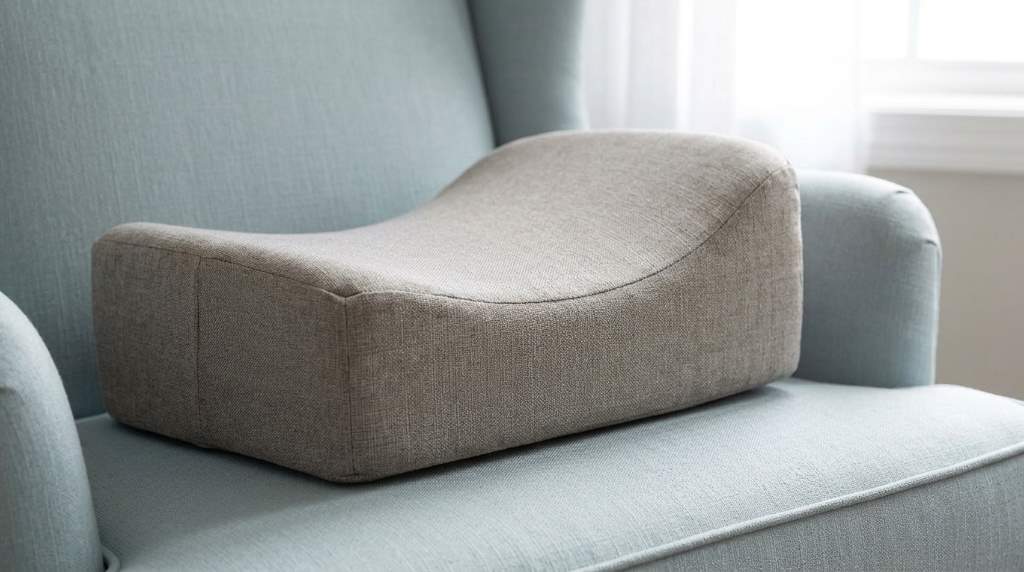
This can be especially helpful during:
- Long breastfeeding sessions
- Frequent newborn feeds
- Cross-cradle positioning
- Football holds
- Bottle feeding
- Postpartum recovery
- Feeding while seated in a chair or on a couch
- Families with different-sized caregivers
That said, nursing pillows are highly personal. Some parents use one at nearly every feed, while others prefer a regular pillow, reclined feeding, or no pillow at all. Breastfeeding support organizations and parent experiences make one point clear: there is no single feeding setup that works for everyone.
7 Things to Look for in the Best Breastfeeding Pillow
1. The Right Height
Height is one of the most overlooked factors when choosing a breastfeeding pillow.
If the pillow is too low, you may find yourself leaning forward to reach your baby. Over time, that position can become uncomfortable. If the pillow is too high, your baby may sit awkwardly relative to your breast.
Look for a pillow that places your baby at a natural feeding height while allowing you to keep your shoulders relaxed.
A pillow that works beautifully for one parent may be completely wrong for another because torso length, breast position, chair height, and baby’s size all affect the ideal setup.
2. Firm but Comfortable Support
A nursing pillow should generally have enough structure to hold its shape during feeding.
An extremely soft pillow may compress under your baby’s weight, forcing you to readjust repeatedly. On the other hand, a pillow that feels excessively rigid may not conform comfortably to your body.
The sweet spot is dependable support with enough cushioning for extended use.
Memory foam and other structured fills are becoming common in newer nursing-pillow designs. Momcozy, for example, currently offers memory-foam-based nursing pillows alongside adjustable designs.
3. A Secure Fit Around Your Waist
A pillow that slides away every time your baby moves can quickly become frustrating.
For that reason, an adjustable waist strap can be a valuable feature. It lets the pillow stay closer to your body and may provide a more consistent fit across different body types.
This is particularly useful if more than one caregiver will use the same pillow.
Some current Momcozy models, for example, use adjustable straps and wider side sections to provide additional arm support.
4. Enough Surface Area for Your Arms
A nursing pillow isn’t only supporting the baby. Ideally, it should also help support your arms.
If the sides are too narrow, your elbows and forearms may hang off the pillow, defeating part of the purpose.
A wider design can be helpful for parents who have longer arms, larger frames, or who prefer additional elbow support during extended feeds.
5. An Easy-to-Clean Cover
Spit-up, leaking milk, formula, diaper accidents, and everyday messes are simply part of life with a newborn.
A removable, washable cover can therefore be more valuable than a decorative feature that looks impressive in a product photo.
Before buying, check:
- Whether the cover is removable
- Whether it is machine washable
- Whether replacement covers are available
- Whether the inner pillow can be cleaned according to the manufacturer’s instructions
If you’re going to use the pillow several times a day, easy maintenance becomes a practical necessity.
6. Compatibility With Your Feeding Position
The best nursing pillow for breastfeeding should complement the positions you actually use.
For example:
Cradle hold: A curved pillow can provide a convenient platform across the lap.
Cross-cradle hold: Stable support can make it easier to maintain control of the baby’s head and neck while positioning.
Football hold: A wider pillow can provide support underneath the baby’s body and the parent’s arm.
Bottle feeding: A nursing pillow can provide additional arm support, although the caregiver should continue holding and actively supervising the baby.
Don’t buy based solely on the pillow’s shape. Think about how you feed.
7. Clear Safety Instructions
Safety should be part of the buying decision, not an afterthought.
The CPSC’s federal nursing-pillow standard addresses hazards associated with these products, and nursing pillows manufactured after April 23, 2025 are subject to the applicable requirements under 16 CFR Part 1242.
The important distinction is that a nursing pillow is a feeding accessory, not a sleep surface.
The CPSC and AAP both emphasize that pillows and other soft products should not be placed in an infant’s sleep environment.
Nursing Pillow Safety: What Parents Need to Know in 2026
This deserves special attention because modern nursing pillows sometimes include features designed to improve stability.
A safety fence, raised edge, or side support can be useful during supervised feeding, but those features do not turn a nursing pillow into a safe sleeping product.
In 2024, the CPSC approved a mandatory federal safety standard specifically for nursing pillows after identifying serious injury and death risks associated with these products. The standard addresses hazards including suffocation and falls.
The rule became especially relevant in 2025, when the requirements began applying to newly manufactured nursing pillows.
For parents, the practical takeaway is simple:
Use the pillow for its intended purpose, stay with your baby during feeding, follow the manufacturer’s instructions, and never use a nursing pillow as an unattended sleep surface.
The AAP’s safe-sleep guidance is equally clear: infants should sleep on a firm, flat sleep surface without pillows, loose blankets, stuffed toys, or other soft objects.
What About a Nursing Pillow With a Safety Guard?
Safety-guard designs are one of the more noticeable developments in newer nursing pillows.
Momcozy’s current safety-guard nursing pillow, for example, incorporates a raised support area intended to help reduce rolling or slipping during supervised feeding. The company describes a 14-cm security fence on its current model and states that the pillow is designed for feeding and other awake, supervised activities.
If you’re specifically researching this style, you can read our detailed guide to the Momcozy Innovative Safety Guard Nursing Pillow.
The important thing is to evaluate the safety feature in context. A guard can help with positioning during a supervised feed, but it should never be interpreted as permission to leave an infant unattended or allow the baby to sleep on the pillow.
Best Nursing Pillow for C-Section Recovery
Parents recovering from a C-section often have an additional consideration: pressure around the abdominal area can be uncomfortable.
A nursing pillow may help create some separation between the baby and the recovering abdomen, depending on the pillow’s shape, height, and how the parent feeds.
However, comfort varies considerably. A very thick pillow may work well for one person and press against another person’s incision area.
If you’re recovering from surgery, prioritize a pillow that:
- Sits comfortably above or around the area of tenderness
- Does not require you to lean forward
- Provides adequate arm support
- Stays securely positioned
- Can be used without excessive pressure against your abdomen
If you experience significant pain or have concerns about your incision, follow your healthcare professional’s guidance rather than relying on a pillow to solve the problem.
Best Nursing Pillow for Bottle Feeding
Nursing pillows aren’t exclusively for breastfeeding.
They can also be useful during bottle feeding because they provide a convenient surface for supporting your arms and positioning the baby comfortably.
However, don’t interpret “hands-free” marketing literally when it comes to infant feeding. You should continue to actively hold, observe, and respond to your baby.
This is especially important because the AAP and CPSC have highlighted the risks associated with products that can place infants in unsafe positions. In 2026, the AAP also reported on a recall involving self-feeding pillows that could hold a bottle at an unsafe angle and prevent an infant from moving away from the bottle.
A good nursing pillow should support the caregiver—not replace the caregiver.
How to Use a Nursing Pillow Correctly
Start by sitting in a stable, comfortable chair.
Place the nursing pillow securely around your waist or across your lap, depending on its design. Adjust the height and strap so that the pillow stays close to your body.
Next, position your baby so that the baby’s body is aligned appropriately for the feeding position you’re using.
Instead of leaning your torso toward the baby, adjust the pillow or your seating position so the baby comes toward your natural feeding height.
Keep your baby’s head and neck appropriately supported and remain attentive throughout the feed.
If the pillow keeps sliding, your shoulders become tense, or you repeatedly have to lift the baby back into position, the pillow may not be the right height or shape for you.
Are Expensive Nursing Pillows Better?
Not necessarily.
Price can reflect materials, construction, adjustability, brand reputation, or additional features, but cost alone doesn’t determine whether a pillow will work for your body.
A $30 pillow that fits you perfectly can be more useful than a $100 pillow that places your baby too low.
When comparing models, prioritize:
| Feature | Why It Matters |
| Height | Helps bring baby to a comfortable feeding level |
| Firmness | Prevents excessive compression |
| Waist strap | Improves stability and fit |
| Width | Supports arms and baby’s body |
| Washable cover | Makes daily cleanup easier |
| Shape | Determines how well it works with your feeding position |
| Safety instructions | Helps ensure appropriate use |
Think about the features you’ll use every day rather than paying for features you don’t need.
How Long Do You Need a Nursing Pillow?
There is no universal expiration date for a nursing pillow based simply on your baby’s age.
Some parents use one heavily during the newborn period and gradually stop as their baby becomes stronger and feeding becomes quicker. Others continue using one for many months.
The important question is whether the pillow still fits your feeding routine.
As your baby grows, you may notice that the pillow no longer provides the same positioning advantage. At that point, you may naturally transition to feeding without it.
Some manufacturers also market nursing pillows for supervised awake activities beyond feeding. For example, Momcozy currently describes certain models for feeding from birth and later supervised activities such as propping, tummy time, and sitting practice.
Always follow the specific age, weight, activity, and safety instructions supplied with your product.
Frequently Asked Questions
What is the best nursing pillow for breastfeeding?
The best nursing pillow is the one that fits your body, supports your preferred feeding position, stays stable, and places your baby at a comfortable height. There is no universally best model for every parent.
Is a nursing pillow necessary for breastfeeding?
No. A nursing pillow is optional. Some parents find it extremely helpful, while others prefer their lap, a standard pillow, or different breastfeeding positions.
Can I use a nursing pillow for a newborn?
Many nursing pillows are designed for feeding newborns, but always check the manufacturer’s instructions. The pillow should be used only for its intended purpose and under active adult supervision.
Can a baby sleep on a nursing pillow?
No. Nursing pillows should not be used as infant sleep surfaces. The AAP recommends a firm, flat, separate sleep surface without pillows or other soft objects.
Is a nursing pillow good after a C-section?
It can be helpful because it may provide support between the baby and your abdomen and reduce the need to lean forward. Comfort depends on the pillow’s shape and your recovery.
Can dads use nursing pillows?
Absolutely. Nursing pillows can be useful for bottle feeding and general supervised infant support, so they aren’t limited to breastfeeding parents.
What is better: a soft or firm nursing pillow?
A supportive, moderately firm pillow is generally more useful than one that collapses easily. The ideal firmness depends on your body, baby’s size, and preferred feeding position.
Are nursing pillows safe in 2026?
Nursing pillows are subject to federal safety requirements, including the CPSC’s nursing-pillow standard under 16 CFR Part 1242. However, safe use still depends on following the manufacturer’s instructions and never using the pillow as an infant sleep surface.
Final Verdict
Choosing the best nursing pillow for breastfeeding is less about finding the pillow with the longest feature list and more about finding one that works with your actual body and feeding routine.
Start with the basics: proper height, dependable support, a secure fit, enough room for your arms, easy cleaning, and clear safety instructions.
If you’re recovering from a C-section, pay extra attention to pressure around your abdomen. If you have a larger or smaller frame, adjustable designs may provide a better fit. If you frequently bottle-feed, look for a pillow that provides comfortable arm support without encouraging hands-free feeding.
And above all, remember the distinction between feeding support and sleep safety. A nursing pillow can make feeding more comfortable, but it should never replace active supervision or an approved infant sleep surface.
The best choice is ultimately the one that helps you feed comfortably, maintain a good position, and spend less time fighting with the pillow and more time focused on your baby.

