
Key Takeaways
- Gray faux fur pillow covers add softness, texture, and visual depth without requiring a complete bedroom makeover.
- The easiest way to use them is to treat them as a texture layer, not simply another decorative pillow.
- Gray works especially well with white, cream, beige, taupe, charcoal, navy, muted blue, and warm wood tones.
- A balanced pillow arrangement usually combines different sizes, shapes, and textures rather than repeating the same fabric.
- Faux fur looks most polished when the rest of the bedding remains relatively simple.
- Proper care matters because plush textured fabrics can lose their appearance when cleaned or stored incorrectly.
- You can create a high-end-looking bed with a few intentional layers instead of filling the entire surface with pillows.
Why Gray Faux Fur Pillow Covers Are Having a Moment
A bedroom does not need an expensive renovation to feel noticeably more comfortable. Sometimes the biggest difference comes from adding one tactile layer that changes how the room looks and feels.
That is where gray faux fur pillow covers come in.
Faux fur has a naturally plush appearance that immediately makes a bed, reading chair, or sofa feel more inviting. Gray makes the look considerably easier to work with because it sits between dramatic black and bright white. Depending on the surrounding colors, gray can feel modern, cozy, sophisticated, or relaxed.
That versatility is one reason textured pillows continue to show up in contemporary bedroom styling. Recent design coverage has emphasized tactile materials, faux fur, layered textiles, and pillows with more personality rather than perfectly matched bedding sets. Designers are increasingly using texture to make neutral rooms feel warm instead of flat.
For homeowners who want a simple bedroom refresh, that makes a gray faux fur pillow cover a surprisingly useful accessory.
The trick is knowing how to style it.
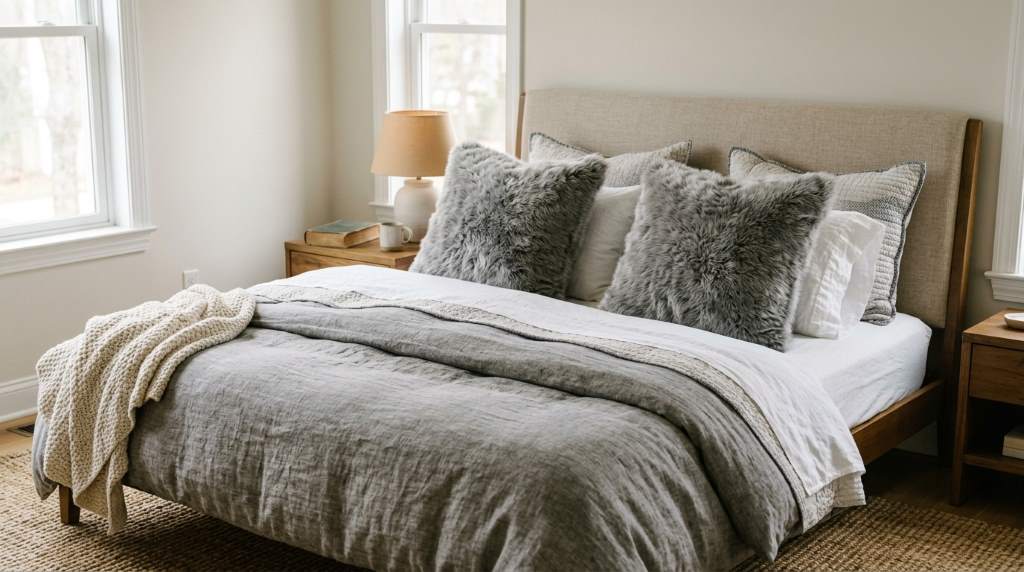
What Makes Gray Faux Fur Pillow Covers So Versatile?
Gray is often treated as a neutral, but not every gray behaves the same way.
A soft, light gray can make a bedroom feel airy and calm. Medium gray provides a little more contrast, while charcoal creates a stronger, more dramatic accent. Faux fur adds another dimension because the material catches light differently from cotton, linen, velvet, or smooth microfiber.
That difference is important.
If every item on your bed has the same smooth finish, the overall arrangement can look visually flat even when the colors coordinate perfectly. Texture gives the eye something else to notice.
Think of the bed as a layered composition:
Color + shape + texture + scale = a more finished look.
A gray faux fur pillow can provide the texture component without introducing another complicated pattern.
7 Ways to Style Gray Faux Fur Pillow Covers
1. Pair Gray Faux Fur With Crisp White Bedding
For a clean, hotel-inspired bedroom, start with white or ivory bedding.
White sheets and a simple duvet create a quiet background. Then use gray faux fur pillows as the tactile accent.
The contrast is subtle but effective. Instead of relying on bold colors, you’re creating interest through material.
Try this combination:
- White or ivory sheets
- A white duvet or comforter
- Two standard sleeping pillows
- One or two gray faux fur accent pillows
- A soft gray or neutral throw at the foot of the bed
This approach works particularly well in minimalist bedrooms because the pillows add warmth without introducing visual clutter.
2. Build a Neutral Bedroom With Multiple Shades of Gray
If you prefer a monochromatic bedroom, don’t be afraid to use several shades of gray.
The key is to vary the texture and tone.
For example, combine a lighter gray duvet with medium-gray decorative pillows and a deeper charcoal accent. The faux fur pillow then becomes the softest-looking layer in the arrangement.
This is much more interesting than purchasing every piece in exactly the same shade.
A useful rule is to stay within a relatively tight color family while changing the materials. You might have cotton sheets, a quilted coverlet, a velvet pillow, and a faux fur accent pillow—all in related neutral tones.
The result feels intentional rather than overly coordinated.
3. Warm Up a Cool Bedroom
Gray can occasionally make a room feel cold when it is paired with too many blue-based neutrals.
If your bedroom already has cool gray walls or flooring, introduce warmer elements around the pillows.
Consider:
- Cream bedding
- Beige or oatmeal textiles
- Natural wood furniture
- Warm white lighting
- Tan or camel accents
- A gray faux fur pillow as the bridge between cool and warm tones
This works because gray doesn’t have to dominate the room. It can simply connect the cooler and warmer elements.
Natural wood is particularly helpful because it adds an organic visual counterpoint to plush synthetic textures.
4. Mix Faux Fur With Velvet
If you want the bed to look more luxurious, combine faux fur with velvet.
These materials work together because they have different visual personalities. Faux fur looks fluffy and relaxed, while velvet appears smooth and refined.
Instead of using several faux fur pillows, let one or two provide the plush texture and use velvet for contrast.
For example:
Back layer: sleeping pillows
Middle layer: larger decorative pillows
Front layer: gray faux fur accent pillow
Finishing layer: smaller velvet or textured pillow
The exact number is less important than the contrast between materials.
5. Add Gray Faux Fur to a Blue Bedroom
Gray and blue are an easy combination when you want a bedroom that feels calm without becoming boring.
Navy, slate, dusty blue, and muted denim can all work with gray, although the overall effect changes depending on the shade.
For a sophisticated look, combine darker blue bedding with medium or light gray accents.
For something softer, use pale blue, cream, and light gray together.
Current bedroom design continues to favor layered color and texture rather than completely flat, single-material spaces. Even when the palette stays restrained, introducing different tactile surfaces gives the room more personality.
6. Use Texture Instead of More Color
One of the best reasons to choose gray faux fur is that it can create visual interest without adding another strong color.
This is especially useful if your bedroom already has artwork, patterned bedding, colorful curtains, or a statement headboard.
Instead of adding another printed pillow, introduce texture.
The faux fur becomes an accent without competing for attention.
This is a practical styling principle: when a room already has enough color, add texture; when it lacks visual energy, consider color or pattern.
That distinction can keep a bedroom from looking overdecorated.
7. Don’t Forget the Chair or Reading Corner
Pillow covers don’t have to stay on the bed.
A gray faux fur accent pillow can also work on:
- A bedroom bench
- A reading chair
- A window seat
- A lounge chair
- A neutral-colored sofa
Moving the same texture around the room can create a stronger sense of cohesion.
If your bedroom has gray or neutral furniture, the pillow can subtly repeat that color while introducing a softer surface.
How Many Decorative Pillows Should You Use?
There is no universal number, but more is not automatically better.
A common mistake is treating a decorative bed like a display shelf. If you need to move ten pillows every night before going to sleep, the arrangement may be working against you.
Instead, focus on hierarchy.
Start with functional sleeping pillows. Add larger decorative pillows behind them if desired. Then place one or two smaller statement pieces toward the front.
Your faux fur pillow can serve as the focal texture.
The objective is not to cover every inch of the bed. It is to create enough layering that the bed looks finished while remaining practical.
How to Mix Pillow Textures Without Making the Bed Look Messy
Texture mixing works best when each material has a distinct role.
A simple combination could include:
| Pillow texture | Visual role |
| Cotton or linen | Clean, understated foundation |
| Quilted fabric | Adds subtle dimension |
| Velvet | Adds smooth, refined contrast |
| Faux fur | Provides plush, cozy texture |
| Woven fabric | Adds casual or organic character |
You don’t need all five.
Two or three contrasting textures are usually enough to make a neutral arrangement feel deliberate.
The most important thing is avoiding repetition. If every decorative pillow is fuzzy, the faux fur loses its impact.
How to Choose Colors That Work With Gray Faux Fur
Gray is flexible, but these combinations are especially dependable:
Gray + white: crisp and classic
Gray + cream: warm and relaxed
Gray + beige: soft and sophisticated
Gray + charcoal: dramatic and modern
Gray + navy: polished and calming
Gray + dusty blue: light and serene
Gray + natural wood: warm and organic
Gray + muted green: earthy and contemporary
If you’re unsure, start with three colors: one dominant neutral, one secondary neutral, and one accent.
For example:
60% cream + 30% gray + 10% muted blue
You don’t have to measure your room literally. The idea is simply to establish a visual hierarchy instead of giving every color equal attention.
How to Keep Faux Fur Looking Its Best
Before cleaning any faux fur pillow cover, check the manufacturer’s care instructions on the specific product. Faux fur can vary significantly in fiber construction and backing, so a cleaning method that works for one cover may not be appropriate for another.
In general, avoid assuming that every faux fur item should be treated like ordinary cotton bedding.
A few sensible habits can help:
- Follow the care label rather than relying on generic laundry advice.
- Avoid excessive heat unless the manufacturer specifically permits it.
- Don’t use harsh cleaning methods simply because the material is synthetic.
- Allow the fabric to dry according to the manufacturer’s instructions.
- Store plush covers in a clean, dry place.
- Avoid compressing the fur under heavy items for long periods.
If the cover becomes flattened after storage, gentle handling may help restore its appearance, but again, the manufacturer’s instructions should take priority.
Where to Find the Right Gray Faux Fur Pillow Cover
If you’re specifically looking for a gray faux fur accent for your bedroom, you can see the [Pallene Grey Faux Fur Pillow Covers from Peak Pillows] for a dedicated example of this style and color direction.
The important thing is to think beyond the individual pillow. A decorative cover works best when it has a relationship with the bedding, furniture, lighting, and other textures in the room.
Are Gray Faux Fur Pillows Still Stylish in 2026?
Yes—but the way they’re being used matters.
Current bedroom design is moving toward spaces that feel personal, comfortable, and layered rather than overly staged. Recent design coverage has highlighted everything from plush faux-fur pillows to oversized bolster pillows and mixed textures as ways to give a bedroom more character.
That doesn’t mean every trend needs to be followed literally.
The more lasting approach is to use texture where the room needs it. A gray faux fur pillow can work in a contemporary bedroom, a cozy transitional space, a neutral guest room, or a more glamorous setting because the neutral color allows the material—not a loud pattern—to make the statement.
In other words, the appeal is less about chasing a trend and more about using texture intelligently.
Common Styling Mistakes to Avoid
Matching everything too closely
A perfectly matched pillow set can make a bedroom look predictable. Introduce at least some variation in texture, shape, or shade.
Using too many statement pillows
If every pillow is competing for attention, none of them becomes a focal point.
Ignoring the rest of the room
A gray faux fur pillow should relate to something else—perhaps the wall color, rug, curtains, furniture, or another textile.
Choosing texture without considering practicality
A pillow that looks beautiful but is difficult to maintain may become frustrating over time. Consider where you’ll use it and how frequently it will need cleaning.
Forgetting scale
A small accent pillow can disappear against oversized bedding, while an oversized pillow can overwhelm a compact bed. Balance the pillow size with the scale of the furniture.
FAQs About Gray Faux Fur Pillow Covers
Are gray faux fur pillow covers good for a bedroom?
Yes. Gray faux fur can add softness and visual depth while remaining relatively easy to coordinate with neutral bedding. It is particularly useful when a bedroom needs more texture rather than more color.
What colors go best with gray faux fur pillows?
White, cream, beige, charcoal, navy, muted blue, natural wood tones, and soft green are all versatile choices. The best combination depends on whether you want the room to feel warm, cool, dramatic, or minimalist.
Can I use faux fur pillows on a sofa?
Absolutely. A gray faux fur pillow can work on a sofa, accent chair, reading chair, or bedroom bench. Its neutral color makes it easier to move between rooms and decorating styles.
How many decorative pillows should go on a bed?
There is no fixed rule. A practical arrangement typically combines functional pillows with a few decorative layers. Prioritize different sizes and textures rather than simply adding more pillows.
How do I make faux fur pillows look less over-the-top?
Keep the surrounding bedding simple. Pair the faux fur with solid colors and understated textures rather than multiple bold patterns. One or two plush pillows can have more impact than an entire collection.
Is gray faux fur suitable for a minimalist bedroom?
Yes. Minimalism does not have to mean eliminating texture. In fact, a single gray faux fur pillow can add warmth and tactile interest while keeping the overall color palette restrained.
How should I wash a faux fur pillow cover?
Follow the specific care instructions supplied with the cover. Faux fur products can differ in construction, and heat or aggressive washing may damage some materials.
Final Thoughts
A bedroom can feel dramatically more inviting without a dramatic makeover.
Gray faux fur pillow covers are a simple way to introduce the kind of texture that makes bedding look layered, comfortable, and considered. Their neutral color keeps them versatile, while the plush surface gives them enough personality to stand out.
Start with your existing bedding rather than rebuilding the entire room around a pillow. Look at the colors you already have, identify where the room feels visually flat, and use texture to fill that gap.
If your bedding is bright and clean, gray faux fur can provide contrast. If your bedroom is already gray, use different shades and materials to create depth. If the room feels cold, combine the gray with cream, beige, wood, or warmer lighting.
The goal isn’t to make the bed look like a showroom.
It is to make the room feel like somewhere you actually want to spend time.
And that is ultimately what good bedroom styling should accomplish: comfort first, personality second, and decoration that supports both.

